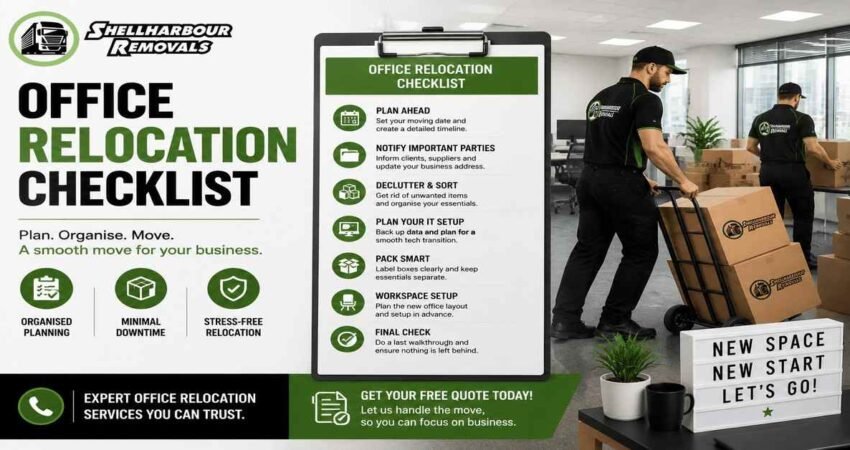
Office Relocation Checklist for Shellharbour Businesses
Most office moves that go wrong don’t fail on moving day. They fail months earlier, when nobody assigned clear ownership of the lease review, the IT shutdown plan, or the change of address notifications.
A complete office relocation checklist covers six phases: strategic planning from 12+ months out, vendor selection and staff communication at 6-12 months, IT and furniture planning at 3-6 months, final notifications and dilapidation at 1-3 months, moving day execution, and a 30-60-90 day post-move productivity ramp-up. Each phase has specific tasks, owners, and deadlines that keep your business running without gaps.
This guide walks through every phase in sequence, so your team knows exactly what to do and when.
—
12+ Months Before Your Office Move: Strategic Planning
Starting your office relocation checklist more than a year out feels excessive until you’re three months from your lease end date with no signed heads of agreement on the new premises. That gap is where businesses lose money fast.
Lease Review Checklist
Your current lease is the first document to open, not the last. Read the make-good and dilapidation clauses before you do anything else, because the cost of restoring your current tenancy to its original condition can run into tens of thousands of dollars for a mid-sized office. Note the notice period required to vacate, any rent-free periods that may affect your exit timing, and any restrictions on sub-letting.
On the new space side, engage a tenant’s representative or commercial lawyer to review heads of agreement before you sign. Check permitted use clauses, fit-out approval processes, and whether the landlord will contribute to the cost of any new works. In the Illawarra and Wollongong commercial market, getting independent lease advice at this stage routinely saves businesses more than the cost of the advice itself.
Key lease review tasks at 12+ months:
- Confirm notice to vacate deadline
- Document make-good obligations in writing
- Commission an independent condition report on current premises
- Assess new space against your headcount forecast for the next three years
- Confirm zoning and permitted use for your business type
Budget Setting and Cost Breakdown
Office relocation costs break into three broad buckets: property costs, fit-out and setup costs, and logistics costs. Property costs include make-good at your old premises and any incentive works or contributions at the new one. Fit-out covers cabling, partitioning, furniture, and signage. Logistics covers the physical move: removalist fees, IT decommissioning, packing materials, and temporary storage if your move-in date and move-out date don’t align.
Build a contingency of at least 15% into your total budget. Dates slip, make-good assessors find damage that wasn’t in the original report, and IT migrations almost always take longer than the estimate. A written budget with named cost owners keeps the project financially accountable from this point forward.
Download or create a master office relocation checklist template at this stage. A shared spreadsheet or project management tool with tasks, owners, deadlines, and budget line items gives everyone on the team a single source of truth.
—
6-12 Months Out: Vendor Selection and Employee Communication
With your lease position confirmed and budget approved, the 6-12 month window is for locking in the suppliers and people who will actually execute the move.
Moving Company Selection
Get at least three written quotes from commercial removalists, and make sure each quote is based on an in-person or video assessment of your current premises, not a rough estimate by email. Ask specifically about their process for moving IT equipment, whether they carry goods-in-transit insurance, and how they handle access restrictions like loading dock bookings or after-hours access requirements.
For businesses in the Shellharbour, Wollongong, Kiama, and wider Illawarra region, working with a local commercial removalist who already knows the access conditions at sites across the area saves negotiation time on moving day. A removalist unfamiliar with the area may not account for loading dock booking windows or building management requirements at commercial addresses.
Check references for office moves specifically, not just residential jobs. The skills overlap, but the planning requirements differ. A removalist who has moved 20 residential homes and no offices is a different proposition from one with a track record in commercial moving services.
Employee Notification and Change Management
Your staff need structured, early communication, not a single email two weeks before the move. Start with an all-hands announcement at the 9-12 month mark. Follow with department-level briefings that address commute changes, parking availability, and any changes to workstation arrangements. Designate a move coordinator per department to act as the point of contact for questions and to oversee packing responsibilities within their area.
Send a written relocation timeline to all staff at the 6-month mark. Include key dates: when personal items must be packed, when IT equipment will be decommissioned at the old site, and when the new office will be operational. Staff who understand the schedule cooperate with it; staff who feel surprised by it don’t.
Daniel Roberts, who engaged a commercial removalist for an office move, noted the experience was “professional… affordable pricing and excellent communication.” That communication standard starts internally, before any removalist is on site.
—
3-6 Months Before: Detailed IT and Furniture Planning
The 3-6 month window is where office moves get technical. IT migration and furniture decisions made carelessly here create the bulk of moving-day disruptions.
IT Relocation Checklist with Security Steps
An IT relocation checklist runs separately from, but in parallel with, the physical move plan. Start by auditing every device, server, cable run, and peripheral in the current office. Label everything at the asset level, not just the rack or desk level.
IT relocation checklist tasks:
- Complete a full device and software asset register
- Back up all servers and confirm backup integrity before decommissioning begins
- Contact your internet and phone providers to arrange connection at the new site, allowing 6-8 weeks minimum for provisioning
- Arrange secure data destruction for any hardware being retired, in line with the Australian Privacy Act 1988 requirements
- Plan the cabling layout for the new space before fit-out begins, not after
- Coordinate with your IT provider on a phased shutdown plan that keeps core systems online during the move window
- Test VPN and remote access from the new site before staff arrive
Security is the step most businesses skip under time pressure. Any device containing client data should be tracked by serial number, transported in a locked container, and signed in at the new site. Treat the physical move of IT hardware with the same rigour as a software security audit.
Furniture and Inventory Planning
Walk every room of the current office and make a decision on each piece of furniture: move it, sell it, donate it, or dispose of it. Don’t defer this decision to the week before the move. Surplus furniture that arrives at the new site without a designated space creates congestion and cost on moving day.
Draw a scaled floor plan of the new office and assign every workstation, chair, desk, filing cabinet, and appliance a position before the truck arrives. Send that floor plan to your removalist so the crew can place items directly rather than staging everything in one room for your team to sort later. This single step cuts post-move setup time substantially.
Check whether any large or heavy items, such as a server rack, industrial printer, or reception desk, need specialist handling or disassembly. Arrange that with your removalist at this stage, not on moving day.
—
1-3 Months Before: Final Preparations and Notifications
The final quarter of your office relocation planning is about locking in every external notification and confirming your physical exit obligations.
Change of Address Notifications
Compile a master list of every organisation and contact that holds your current business address. The list will be longer than you expect.
Change of address notification list:
- Australian Business Register (update your ABN address)
- Australian Taxation Office
- State revenue office
- All business bank accounts and financial institutions
- Insurance providers
- Superannuation funds
- Clients and customers (direct email, website, email signature update)
- Suppliers and contractors
- Utilities: electricity, gas, water, internet, phone
- Australia Post mail redirection (arrange at least 4 weeks in advance)
- Professional associations and licences
- Google Business Profile and any online directory listings
Schedule the notifications in batches by category. Critical financial and legal notifications go first. Client-facing updates go out no later than two weeks before the move date, with a follow-up reminder on move day itself.
Office Lease Review Checklist and Dilapidation
Commission a formal dilapidation report on your current premises now, before you begin any make-good works. The report documents the current condition and gives you a reference point if the landlord disputes your make-good scope at exit. In New South Wales, make-good obligations are enforceable under the terms of the lease, and disputes can delay your final exit date and trigger penalty rent.
Dilapidation tasks at 1-3 months:
- Obtain written make-good specification from landlord or property manager
- Get two or three quotes from licensed contractors for any repair or reinstatement works
- Confirm which fixtures, fittings, or fit-out items the landlord wants removed versus retained
- Book contractor works well before the vacate date to allow for defect rectification time
- Confirm final inspection date with the landlord in writing
At the new premises, complete a pre-occupancy condition report on the day you receive keys. Photograph every wall, floor, and fixture. This protects your bond or security deposit at the end of your new lease term.
—
Moving Day and Immediate Post-Move Setup
Moving day is execution, not planning. Every decision that hasn’t been made by now will slow the move down and cost your business hours of productivity.
Decommission Old Office
Decommissioning runs in parallel with the physical removal. Assign one person to oversee the old site and one to receive at the new site. They should both have copies of the floor plan, the asset register, and the removalist’s contact details.
Decommission tasks on moving day:
- Confirm all personal items are packed and labelled by department
- Remove all wall fixings, shelving, and signage that must be taken or patched under your make-good obligations
- Photograph every room before the removalists begin and again after the last item leaves
- Return all keys, access cards, and security fobs to the building manager
- Confirm utility disconnection or transfer dates with each provider
- Do a final walk of every room, including bathrooms, storage rooms, and the carpark
At the new site, your nominated receiver checks items off the asset register as they arrive. Anything damaged in transit gets photographed and reported to the removalist before the crew leaves the site.
Post-Move Testing and Onboarding
No staff member should begin working at the new site until these systems are confirmed operational: internet connectivity, phone lines, printing, access control, and any cloud or server-based software your team relies on. Run this test checklist the afternoon before staff arrive, not on the morning of day one.
Brief all staff on the new building’s emergency procedures, including fire exits, first aid locations, and evacuation assembly points. This is a legal requirement under the Work Health and Safety Act 2011, not optional onboarding. Post the emergency plan in a visible location before anyone begins work.
—
30-60-90 Day Post-Move Productivity Ramp-Up
The physical move ends when the truck leaves. The operational move continues for three months. Businesses that don’t track the post-move period often absorb productivity losses they never identify or address.
First 30 Days: Stabilisation
The first 30 days are about making the new space work as planned, not as assumed. Walk the office with department heads at the end of week two and note every friction point: rooms that are too warm, workstations that need repositioning, connectivity issues that emerged under full load, or storage that turned out to be insufficient.
30-day stabilisation tasks:
- Confirm all IT systems are operating at full capacity
- Resolve any outstanding make-good or defect issues at both sites
- Collect written feedback from staff on the new layout and working conditions
- Confirm all change of address updates have been processed by external parties
- Review actual relocation spend against budget and document any variances
Clients and suppliers should have received your new address by now. A proactive follow-up call to your top 10 clients confirming the move and your continued availability reinforces confidence in your business during the transition period.
60-90 Days: Optimisation Metrics
At the 60 and 90-day marks, measure the new office against the business case you built at the 12-month planning stage. JLL and WeWork both identify 90 days as the point at which occupancy patterns, space utilisation, and staff satisfaction stabilise enough to draw meaningful conclusions.
Metrics to assess at 60-90 days:
- Staff attendance and desk utilisation rates against the new floorplan assumptions
- Any recurring IT, connectivity, or infrastructure issues
- Client feedback or any service disruptions attributable to the move
- Outstanding lease items at either the old or new premises
- Comparison of post-move operating costs against the pre-move budget model
If the new space isn’t performing against your original business case, act at 90 days, not 12 months. Lease terms, fit-out configurations, and technology setups are all adjustable in the early months of a tenancy. They become much harder to change once everyone has adapted to working around the problem.
—
Why Shellharbour Removals Is the Right Commercial Moving Partner
Small-to-medium businesses across the Illawarra, Wollongong, Shellharbour, and Southern Highlands regions rely on a removalist who understands commercial timelines, not just residential ones. Shellharbour Removals brings 11+ years of local experience, 1,267+ completed jobs, and 846+ trusted clients to every office relocation.
- Office-specific capability: The team handles desks, filing cabinets, IT equipment, and office furniture with the same care applied to residential moves, coordinating with building managers on loading dock access and after-hours bookings.
- Transparent 3-step process: Packing, loading, and unloading, with clear communication at every stage, so your team knows what is happening and when.
- End-to-end service: Optional packing and unpacking support reduces the burden on your internal move coordinator and keeps your staff focused on their work.
- Local knowledge: The team operates daily across Wollongong, Shellharbour, Kiama, Dapto, Fairy Meadow, Figtree, Warrawong, and the Southern Highlands, so access conditions, parking, and building requirements at commercial sites across the region are already familiar.
- Responsive availability: The team is on call 8 AM to 5 PM daily for quote requests, planning questions, and move-day coordination.
Daniel Roberts described his office move experience as “professional… affordable pricing and excellent communication.” That outcome starts with the right moving partner from day one.
—
Frequently Asked Questions
What should be included in an office relocation checklist?
An office relocation checklist should cover lease review and make-good obligations, budget planning, moving company selection, employee communication, IT and furniture planning, change of address notifications, dilapidation, moving day execution, and a 30-60-90 day post-move review. Assigning a named task owner and deadline to each item keeps the process on track.
How do you prepare for an office move in Sydney?
Preparing for an office move in Sydney or the greater NSW region starts 12 months out with lease review and budget setting. At 6-12 months, lock in your removalist and brief all staff. At 3-6 months, complete your IT migration plan and furniture inventory. Allow extra lead time for internet provisioning and building access approvals at Sydney commercial addresses, which can run to 8 weeks or more.
What insurance is needed during an office relocation?
Your removalist should carry goods-in-transit insurance that covers office furniture and equipment during the physical move. Separately, check that your existing business contents insurance covers items during transit and at a temporary location. For high-value IT equipment or specialist machinery, a transit-specific extension or standalone policy may be needed. Confirm all coverage in writing before moving day.
How can businesses minimise downtime during a move?
Businesses minimise downtime by moving in stages rather than all at once, keeping core IT systems live until the new site is confirmed operational, and scheduling the physical move over a weekend or public holiday where possible. A detailed floor plan sent to your removalist in advance allows the crew to place items directly, cutting setup time at the new site from days to hours.
What is a typical office relocation cost breakdown?
Office relocation costs fall across three categories: property costs, including make-good and new fit-out contributions; fit-out and setup, covering cabling, furniture, and signage; and logistics costs, including removalist fees, IT decommissioning, packing materials, and any temporary storage. A 15% contingency on top of your total estimated budget is the standard buffer for mid-sized Australian office moves.
—
Plan Your Move with Confidence
A well-structured office relocation checklist turns a high-pressure project into a manageable sequence of tasks with clear owners and deadlines. Start at 12 months out, work through each phase, and you arrive at moving day with nothing left to improvise.
To get a quote for your office move across Shellharbour, Wollongong, Kiama, or anywhere in the Illawarra and Southern Highlands, contact Shellharbour Removals at 0449 994 831 or email info@shellharbourremovals.com.au. The team is available daily from 8 AM to 5 PM.
—